




Therapy for Working Moms: What No One Talks About When You're Holding Everything Together

June 29, 2026

There is a specific kind of exhaustion that does not show up on any to-do list. It lives in the pause between finishing one thing and starting the next. It is the weight of knowing everything that needs to happen, tracking everyone's needs, and somehow still feeling like you are falling short. If you are a working mom, you know exactly what this feels like.

I am Tamara Pancoe, a women's therapist and I work with women who look like they have it all together but feel anything but that on the inside. If you are a working mom who is tired of performing calm while quietly falling apart, you have found the right place. My therapy for women is built around exactly this kind of invisible, relentless pressure, and what it takes to actually move through it.

The invisible load working moms carry

There is a term researchers use called cognitive load, and for working moms, it rarely switches off. It is not just the tasks themselves. It is the mental architecture behind them: knowing that the permission slip is due Thursday, that your daughter has been quieter than usual this week, that the pediatrician appointment needs to be rescheduled, that you promised to bring something to the school event, and that you still need to follow up on that email from two days ago.

This invisible labor is real work. It requires attention, memory, emotional attunement, and constant anticipation. And because it happens inside your head rather than on a spreadsheet, it often goes unacknowledged, even by you. You just absorb it, carry it, and keep moving. According to the American Psychological Association, women consistently report higher levels of stress than men, and working mothers are among the most affected groups.

The cost of carrying this load silently is not always dramatic. It shows up in small ways: the short temper at the end of the day, the guilt that follows, the difficulty being present even when you are physically there, the sense that you are always one step behind no matter how hard you try.

What is mental load and why does it fall on moms?

Mental load is the cognitive work of managing a household and family: remembering the doctor's appointments, tracking what food is running low, knowing which kid has a project due, noticing when someone is off emotionally and needs extra attention. It is invisible, constant, and almost never fully shared.

For working moms, this mental load runs in the background all day, on top of actual job responsibilities. Anxiety therapy often starts here, with naming the weight, recognizing it as real work, and beginning to explore why so much of it landed on you in the first place.

How working from home blurs the line between work and self

If you work from home, the boundaries between your professional self and your personal self can become almost impossible to maintain. Your laptop is on the kitchen counter. Your Slack notifications go off while you are helping with homework. Your lunch break is spent throwing in a load of laundry. There is no commute to decompress. No physical transition between the two worlds.

Over time, this constant overlap erodes your sense of self. You stop being Tamara or Sarah or whoever you are outside of your roles. You become the manager, the mom, the partner, the cook, the scheduler. And the question of who you are when no one needs anything from you starts to feel almost unanswerable.

 therapy for working moms

Who is happier, stay at home moms or working moms?

This is one of the most searched questions about motherhood. According to research, mothers who maintain professional roles during their children's early years often report higher levels of overall well-being and health compared to those who stay at home. While the choice to work brings its own set of invisible pressures, the data suggests a significant correlation between professional engagement and maternal happiness.

Working moms often report higher levels of self-esteem and financial independence. They also report significantly higher levels of guilt, role conflict, and the pressure of managing two demanding worlds simultaneously. Stay at home moms often report more time with their children but higher rates of loneliness, boredom, and loss of professional identity.

The real issue is not which path is happier. It is that both groups of mothers are often operating without enough support. And for working moms especially, the cultural message is clear: you chose this, so figure it out. That message is not just unhelpful. It is harmful. Happiness is not about the choice you made. It is about the support you have, and the permission you give yourself to actually use it.

What does it mean to cope as a working mom?

The answers you usually find are logistical: batch cook on Sundays, use a shared calendar, lower your standards. And while practical strategies have their place, they address the surface of a much deeper experience. Coping, in the real sense, is not about managing your schedule more efficiently. It is about building a sustainable relationship with all the roles you hold.

Real coping looks like knowing when you are approaching your limit before you hit it. It looks like having language for what you are feeling instead of just pushing through. It looks like understanding your own patterns: why guilt shows up so reliably, why rest feels uncomfortable, why you find it easier to be there for everyone else than to ask for something for yourself.

Some of the most effective approaches for working moms include setting boundaries that are actually maintained rather than just announced, finding one space in your week that is entirely yours, and learning to recognize the difference between a hard season and a pattern that needs to change. Therapy is one place where all of that work can happen without interruption, without judgment, and without you having to take care of anyone else in the room.

The four types of mothers

The first is the responsive mother, who is highly attuned to her children's emotional needs and prioritizes connection. She tends to struggle with boundaries and often gives until she has nothing left. The second is the directive mother, who leads with structure and high expectations. She often excels professionally and organizationally but can feel disconnected from her own emotional life. The third is the permissive mother, who prioritizes harmony and avoids conflict. She carries guilt easily and struggles to hold limits without feeling like she has failed. The fourth is the uninvolved mother, a term that sounds harsh but often describes a woman in survival mode: someone who has given so much that she has emotionally checked out not from lack of love, but from depletion.

What is striking about all four is that burnout lives in each of them. The shape of the exhaustion is different, but the underlying experience, of being stretched beyond what is sustainable, is consistent. Knowing your pattern is useful because it tells you where to look and what kind of support will actually help.

Therapy for working moms

I find that a lot of working moms have a vague idea of what therapy is, but are not quite sure what it would actually look like for them. They imagine lying on a couch talking about their childhood, or showing up and not knowing what to say, or feeling like their problems are not "serious enough" to warrant real support. None of that is how it works here.

Therapy for working moms is a space to slow down and actually hear yourself. To say the things you cannot say anywhere else. To untangle what you are feeling, understand where it comes from, and start making choices that align with who you actually want to be, not just who you think you need to be.

What can a therapist help a working mom with?

A therapist can help you with the specific patterns that keep showing up in your life. Anxiety that will not quiet down. The constant guilt of feeling like you are never enough in any role. The anger that flares up and then leaves you feeling ashamed. The disconnection from your partner because there is nothing left of you by the end of the day. The identity loss that comes with being so defined by your roles that you have forgotten what you actually want.

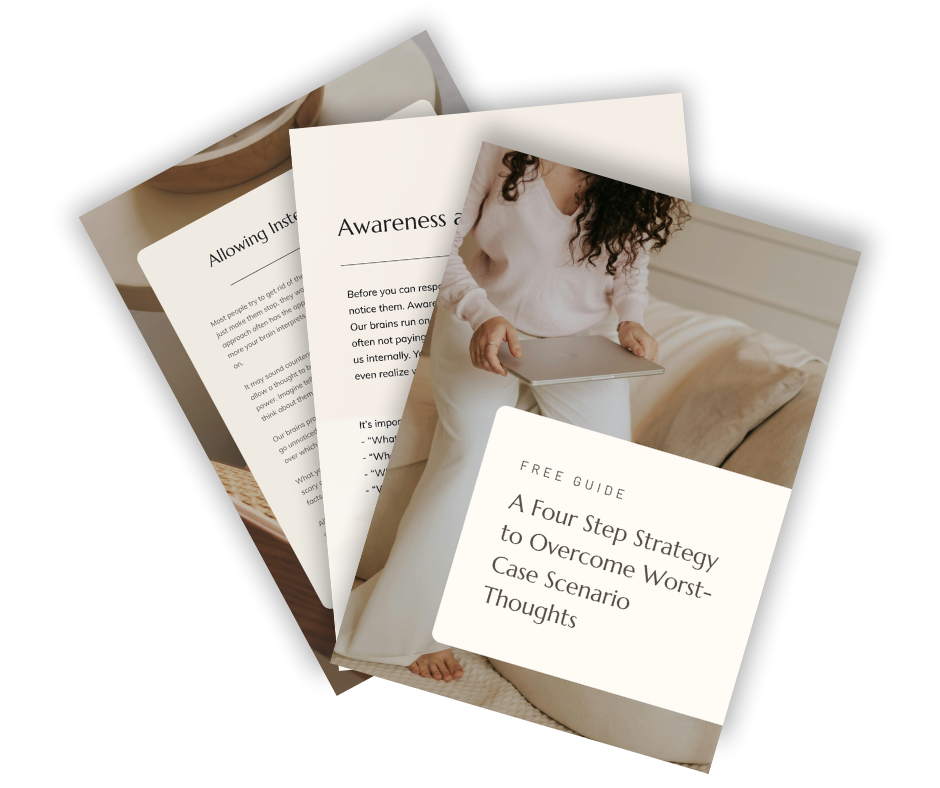
These are not small things. And they are not things you should have to figure out alone. A good therapist helps you see yourself more clearly and gives you the tools and insight to actually shift the patterns that are keeping you stuck. You can also explore my four-step method to help you soften anxious thoughts if you want a first step before booking a session.

You do not have to keep carrying this alone

If you have read this far, something in this resonated. Whatever it was, that recognition matters. It is not just exhaustion talking. It is the part of you that knows something needs to change.

You do not have to wait until you hit a wall to deserve support. You do not have to have it bad enough. You just have to be willing to stop putting yourself last for one hour a week and see what becomes possible when someone is finally in your corner.

If you are ready to stop performing calmly and start finding it, I would love to support you. Reach out today to learn more about therapy in Mill Valley, CA and therapy in San Francisco and take the first step toward finally feeling like yourself again.

Hi, I’m Tamara. I’m so glad you’ve found your way here.

I am a licensed therapist dedicated to helping my clients heal and find hope while navigating the waves of life.

 emotional support for women
July 8, 2026
You deserve real emotional support. Tamara Pancoe offers therapy for women in Marin County and the Bay Area to help you stop carrying it all alone.

therapy for burnout
June 29, 2026
Burnout is more than being tired. Tamara Pancoe offers therapy for burnout in Marin County and the Bay Area to help women finally heal from the inside out.